

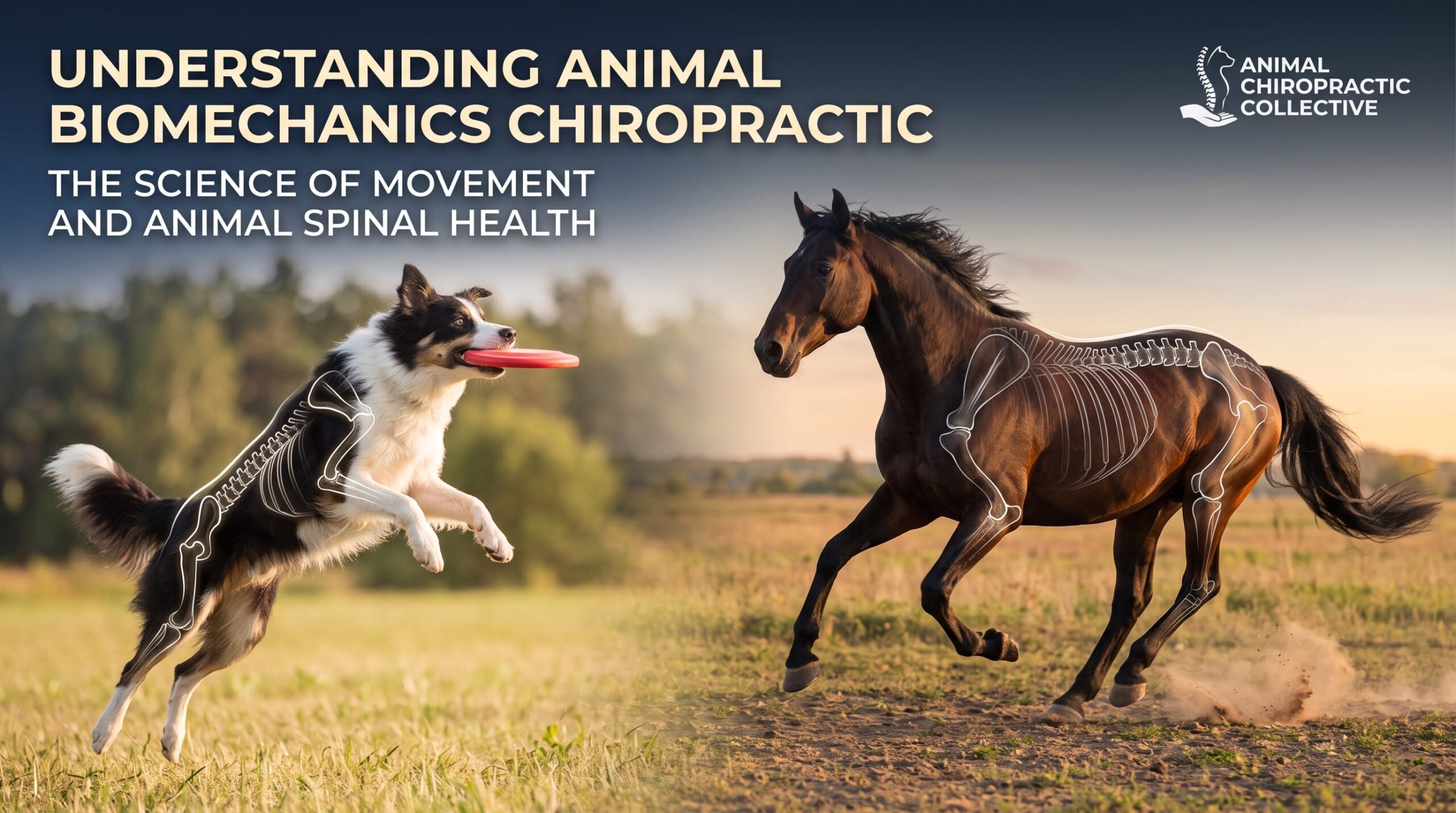
The Science of Movement: Exploring Animal Biomechanics Chiropractic
The animal body is a complex, linked system where every structure plays a role in motion. When an animal walks, runs, or jumps, they rely on a coordinated effort between bones, joints, muscles, and nerves. This interconnected web is known as the kinetic chain. In a healthy kinetic chain, forces are distributed evenly, and movement appears effortless. However, when one part of this musculoskeletal system loses its normal motion, the entire chain is affected.
This concept is the foundation of animal biomechanics chiropractic, a science-based discipline defined as the application of mechanical laws of movement to the assessment and manual treatment of the animal spine and joints. It focuses specifically on how physical forces, posture, and joint motion interact within the animal body.
Understanding the kinetic chain is essential for recognizing how animals compensate for restricted movement. If a joint in the spine or a limb becomes stiff, the body must still find a way to move. To achieve this, the animal shifts its weight and alters its gait. This abnormal motion changes how loads are distributed throughout the body. Over time, these compensatory gait patterns can lead to the overuse of other muscles and joints, creating secondary areas of tension and restriction.
Animal biomechanics chiropractic does not operate outside of established science. It is a distinct, doctor-level discipline entered by two kinds of professionals: doctors of chiropractic (DCs) and doctors of veterinary medicine (DVMs). These practitioners bring their full professional identity into a shared third discipline. It is a highly specialized, targeted approach to diagnosing and treating spinal and joint dysfunction to support the animal’s overall capacity to move.
To explore the broader foundation of this discipline and the data guiding it, read our pillar post on Animal Chiropractic Research & Evidence.
Sources:
Veterinary Chiropractic – University of Toronto
Chiropractic care for animals – ScienceDirect
The Foundation: Animal Spinal Health
In biomechanical terms, the spine is not just a static column of bones. It serves a vital, dual role in the animal body. First, it acts as a rigid protector of the delicate spinal cord and the roots of the central nervous system. Second, it functions as a highly complex movement engine.
The spine must provide precise segmental motion to allow for efficient locomotion. This includes flexion (bending forward), extension (bending backward), lateral bending (side-to-side movement), and rotation. When assessing animal spinal health, practitioners do not merely look for the absence of pain. They evaluate spinal health as a multi-dimensional state of function.
This functional state of health is broken down into three specific dimensions:
The Mechanical Dimension
The mechanical aspect of the spine focuses on the physical movement of the joints. Optimization of a normal range of motion is the primary goal. When evaluating mechanics, practitioners look for symmetrical joint loading, meaning the forces of gravity and movement are balanced evenly across the spine.
A key indicator of mechanical health is a smooth “end-feel.” The end-feel is the specific quality of tissue resistance a doctor feels at the absolute limit of a joint’s normal motion. A healthy joint has a springy, resilient end-feel. In contrast, a dysfunctional joint may present with a rigid, abrupt restriction, indicating that the normal mechanical glide of the joint surfaces is compromised.
The Neurological Dimension
Because the spine houses and protects the central nervous system, mechanical joint function is intimately tied to neurological function. The joints, ligaments, and muscles of the spine are packed with mechanoreceptors—specialized nerve endings that detect movement and position.
When a spinal segment loses its normal motion, it is hypothesized that this segmental dysfunction may alter sensory signaling. This incoming sensory information is called afferent input. If the afferent input is altered, the outgoing motor control—the efferent output—may also change. While direct neurological data in animal chiropractic contexts is still emerging, the understanding of these basic neurological pathways informs the clinical rationale for treatment.
The Functional Dimension
The functional dimension is where mechanical and neurological changes become visible in the animal’s daily life. Changes in spinal health rarely remain hidden. They typically manifest as observable alterations in how the animal moves and behaves.
A practitioner may observe visible changes in gait, such as a shortened stride, a subtle lameness, or a lack of coordination. In working or competing animals, this may appear as a decline in athletic performance. For companion animals, a functional decline might be seen as a reluctance to engage in normal play behaviors, hesitation to jump onto furniture, or difficulty navigating stairs.
Sources:
Veterinary Chiropractic – University of Toronto
Chiropractic care for animals – ScienceDirect
Veterinary Chiropractic – Veterinary Information Network
The Intersection of Veterinary Biomechanics and Chiropractic
To understand how animal chiropractic works, it is necessary to examine where it sits within the broader scope of veterinary sciences. Veterinary biomechanics is the scientific study of how internal and external forces act upon the animal body.
This field focuses specifically on joint motion, muscle dynamics, ground reaction forces, and spinal alignment. By analyzing these factors, professionals can better understand the underlying mechanics of pain, mobility limitations, and athletic performance. Veterinary biomechanics asks how gravity, body weight, and movement impact the musculoskeletal framework.
Animal chiropractic is positioned firmly within this field as a specialized, hands-on application of biomechanical principles. It is defined as the functional diagnosis and correction of dysrelationships between the nervous system and the spinal column. This is achieved through targeted manual spinal manipulation directed at specific, dysfunctional joints.
The profession represents a synthesis of knowledge. Much of the current theory and clinical reasoning in animal chiropractic is adapted from established human chiropractic research. These well-documented human biomechanical principles are carefully adapted for the specific anatomical differences of quadrupeds. The angles of the joints, the orientation of the spine, and the forces of a four-legged gait require a highly specialized application of this knowledge.
Because of this, chiropractic care operates as a complementary facet of care within the broader veterinary diagnostic and safety framework. It is not intended to be a standalone alternative, nor does it serve as a replacement for traditional veterinary medicine. Instead, it provides a unique functional assessment of the kinetic chain.
When a DVM rules out fractures, infections, or surgical pathologies, an animal may still experience mobility issues. This is where the biomechanical expertise of the dual-origin chiropractic profession steps in, assessing the subtle joint restrictions that traditional diagnostics may not prioritize.
Sources:
The Chiropractic Adjustment for Animals – University of Illinois
Chiropractic care for animals – ScienceDirect
The State of the Science: Evidence and Gaps
The animal chiropractic profession is committed to the transparent appraisal of current scientific data. It is important to distinguish clearly between clinical observation—what doctors see working in their daily practice—and the findings of formal, peer-reviewed trials.
Currently, the clinical use of animal chiropractic precedes the formal evidence base. While consistent positive results are routinely observed and documented in practice, large-scale, blinded, randomized controlled trials in veterinary populations remain limited. However, targeted research is growing, and emerging studies offer valuable insights into how these therapies impact animal health.
The Boxer Spondylosis Study (2021)
A notable contribution to the literature is a 2021 study examining the effects of chiropractic care on the development of spondylosis deformans in young Boxer dogs. Spondylosis is a degenerative spinal condition characterized by the formation of bone spurs (osteophytes) along the vertebrae.
The researchers found that regular chiropractic evaluations and treatments were associated with a significantly lower frequency of radiographic spondylosis. In the treated group, only 25.0% of the dogs developed the condition, compared to 46.5% in the control group.
While these findings are promising, it is critical to acknowledge the limitations of the data. The study was limited to a single breed and a specific population. Furthermore, the researchers did not find a direct mathematical correlation between the total number of restricted joints found during exams and the eventual development of the bone spurs. This illustrates that the exact mechanisms of how manual therapy influences spinal degeneration are complex and still being actively explored.
Clinical Reasoning and Evidence Extrapolation
When large-scale veterinary trials are still in development, how do practitioners make informed treatment decisions? A doctor applies chiropractic principles animals can benefit from by grounding their clinical reasoning in established biological sciences.
Decisions are guided by:
- Established Anatomy and Neurology: Practitioners rely on the mapped pathways of the animal nervous system. Understanding segmental innervation and the physiological mechanics of reflex arcs allows doctors to predict how altering joint motion may influence surrounding tissues.
- Human Literature Extrapolation: There is a vast body of general manual-therapy evidence in human medicine regarding joint mobilization, mechanoreceptor stimulation, and pain perception. These foundational physiological concepts are extrapolated and cautiously applied to animal anatomy.
- Monitoring Individual Outcomes: Clinical decisions are continuously refined by monitoring specific, measurable outcomes in the individual animal. Doctors track objective markers such as changes in gait symmetry, improvements in muscle tissue tone, and the restoration of normal joint end-feel.
For a deeper dive into the available literature and how the profession applies it, read The Science Behind Animal Chiropractic: What the Research Says.
Sources:
Effect of Chiropractic Care on Spondylosis in Boxers – PMC
Veterinary Chiropractic – Veterinary Information Network
Clinical Application: From Principles to Practice
Moving from biomechanical theory to clinical practice requires a highly structured process. A visit to an animal chiropractor involves a methodical assessment of the kinetic chain, followed by precise manual interventions tailored to the animal’s specific anatomical needs.
The Biomechanical Assessment
The clinical process begins long before the practitioner’s hands touch the animal. The doctor conducts a detailed visual evaluation of the animal’s gait and posture. They observe the animal at a walk and a trot, analyzing stride length, rhythm, and symmetry. They watch how the animal bears weight and look for subtle compensations, such as a dropped head, a shortened swing phase in a limb, or an arched back.
Following the visual assessment, the doctor performs a rigorous motion palpation exam. This involves physically guiding each individual joint of the spine and extremities through its normal range of motion. The practitioner is actively palpating for the joint’s “end-feel.” They are distinguishing between joints that are springy and healthy, and joints that hit a rigid, restricted stop before reaching their full anatomical potential.
Defining the Adjustment
When a specific, restricted joint is identified, the practitioner may perform a chiropractic adjustment. This is not a generalized massage or a broad stretch. The adjustment is defined as a highly specific, High-Velocity, Low-Amplitude (HVLA) thrust.
The speed (high velocity) is critical because it stimulates the nervous system without triggering the animal’s natural muscle-guarding reflexes. The depth (low amplitude) ensures safety. The thrust is carefully directed along the exact plane of the joint line, aimed at restoring normal joint motion within its anatomical limit. The doctor never forces a joint beyond what it is naturally designed to do.
Hypothesized Mechanisms and Outcomes
The primary goal of this intervention is to improve physical joint mobility and alter neuromuscular input. By restoring motion to a restricted spinal segment, the therapy is thought to change the incoming sensory data to the nervous system, which may subsequently alter pain perception and normalize movement patterns.
In clinical practice, observed outcomes frequently include reports of improved gait efficiency and increased comfort. This is particularly noted in geriatric animals suffering from age-related stiffness, or in animals dealing with compensatory musculoskeletal issues. For example, a dog with hip dysplasia may overload their front limbs and thoracic spine to unweight their painful hips. Chiropractic care focuses on relieving the secondary restrictions in the spine and front limbs, helping the animal manage their overall mobility.
The profession maintains complete transparency that, while these improvements are consistently documented in practice, they are clinical observations rather than the result of blinded trial data.
To explore specific examples of how these biomechanical principles impact individual animals, review our Case Studies in Animal Chiropractic: Real-World Results for Pets and Livestock.
Sources:
Effect of Chiropractic Care on Spondylosis in Boxers – PMC
Chiropractic care for animals – ScienceDirect
The Chiropractic Adjustment for Animals – University of Illinois
Conclusion: A Unified Path Forward
The integration of animal biomechanics chiropractic into the broader landscape of animal care represents a cohesive, unified path forward. It is a vital component of a science-guided wellness strategy that views the animal body as an interconnected system.
By applying rigorous diagnostic standards to optimize animal spinal health, this dual-origin profession provides a highly specific level of care. Understanding the mechanical laws of veterinary biomechanics allows doctors of chiropractic and veterinary medicine to pinpoint subtle functional restrictions that might otherwise go unnoticed.
When joint mechanics are optimized and the nervous system is free from structural interference, practitioners help support the animal’s natural capacity to move, adapt, and perform.
Ultimately, this specialized level of chiropractic care serves as a valuable adjunct to traditional medical management. Whether aimed at supporting an elite equine athlete or helping a senior dog navigate their environment with ease, the profession remains steadfast in its focus. By addressing the precise mechanics of the spine and limbs, the profession works collaboratively to help animals thrive throughout every stage of their lives.
Sources:
Veterinary Chiropractic – Veterinary Information Network
Full Source List
- University of Illinois College of Veterinary Medicine. “The Chiropractic Adjustment for Animals.” Available at: https://vetmed.illinois.edu/pet-health-columns/chiropractic-adjustment-animals/
- University of Toronto. “Veterinary Chiropractic.” Gerstein Science Information Centre. Available at: https://guides.hsict.library.utoronto.ca/c.php?g=746062&p=5402913
- Fábián, N., et al. (2021). “Effect of Chiropractic Care on the Development of Spondylosis Deformans in Boxers: A Retrospective Study.” Animals (Basel). PubMed Central. Available at: https://pmc.ncbi.nlm.nih.gov/articles/PMC8473340/
- Veterinary Information Network (VIN). “Veterinary Chiropractic.” Available at: https://www.vin.com/doc/?id=3843651&meta=generic
- Haussler, K. K. (2017). “Chiropractic care for animals.” ScienceDirect. Available at: https://www.sciencedirect.com/science/article/pii/S0749073917301724
Leave a Reply